Medically grounded | NHS & WHO aligned | Peer-reviewed references
At HEBA Health, many people ask us how to lose 2 pounds a week without resorting to extreme diets or unsafe methods. Two pounds per week is considered a healthy and realistic target for steady weight loss - quick enough to stay motivated, but not so fast that it puts your health at risk or becomes impossible to maintain.
The key is to focus on creating balance: reducing calories in a controlled way, improving the quality of your diet, staying active, and making long-term lifestyle changes.
Why Aim for 2 Pounds a Week?
NHS Guidance. NHS Inform states: try to lose weight gradually - about 1 to 2 pounds (0.5 to 1 kg) per week is a safe and healthy pace. Quick fixes are hard to sustain. NHS Inform - Weight Loss Safety
The reason this target is so widely recommended is that it allows your body to adjust gradually. Rapid weight loss often means you are losing water or muscle rather than fat - and it significantly increases the chance of regaining the weight later.
Losing 2 pounds per week means your body is burning more calories than it consumes, without putting too much strain on your metabolism or energy levels. It is also a target most people can sustain over time.
1–2 lbs
Safe weekly weight loss (NHS)
5–10%
Target body weight reduction in 3–6 months
7–9 hrs
Recommended sleep per night (NHS)
150 min
WHO minimum weekly moderate exercise
Important Warning. Losing weight faster than 2 lbs per week may cause muscle loss, fatigue, hair loss, gallstones, and nutrient deficiencies. Very-low-calorie diets (under 800 kcal/day) should only be used under medical supervision. NICE Guideline CG189
This rate is confirmed by both Royal Marsden NHS Trust and Royal Papworth Hospital NHS - both citing 0.5–1 kg per week as the healthy rate of weight loss.
Understanding the Calorie Deficit
To lose 2 pounds a week, you need to create a calorie deficit - consuming fewer calories than your body burns. One pound of fat is roughly equivalent to 3,500 calories PMC, so losing 2 pounds requires a weekly deficit of around 7,000 calories, or approximately 1,000 calories per day.
Research Note. Modern science - including work published in The Lancet (Hall et al., 2011) - confirms the 3,500 kcal-per-pound rule is a practical starting point, but actual weight loss varies due to metabolic adaptation. Consistency over time matters most. Read study
This does not mean you have to starve yourself. The deficit can be achieved by combining sensible dietary changes with increased physical activity:
| Strategy | Daily Deficit | Example Action |
|---|---|---|
| Diet changes only | ~400 kcal | Smaller portions, less processed food |
| Exercise only | ~400 kcal | 45–60 min brisk walking or cycling |
| Combined | 400 + 400 = 800 kcal | Balanced - more sustainable, preserves muscle |
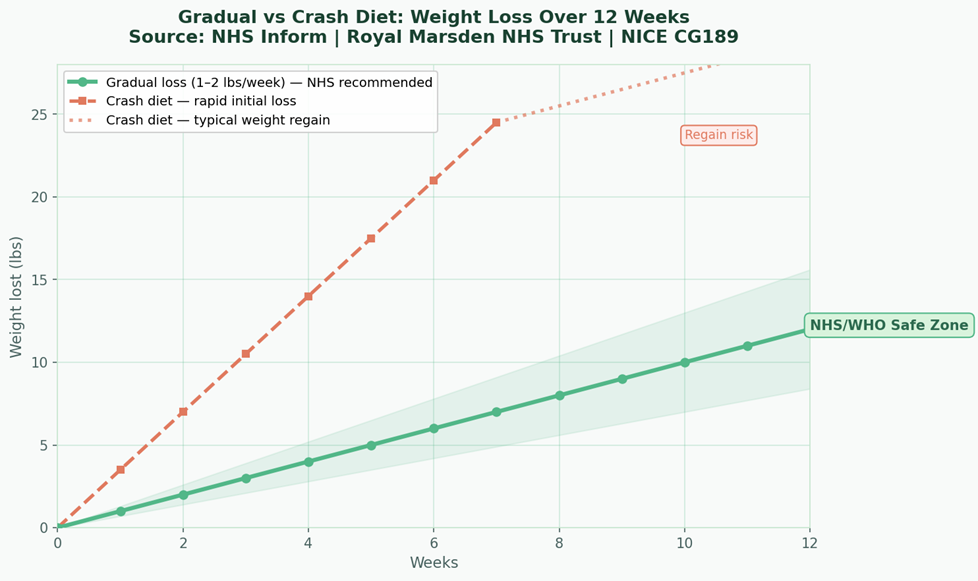
NHS and NICE-aligned guidance typically recommends an initial deficit of around 500–600 calories per day for most adults - this is considered safe and sustainable. NICE/NHS guidance on calorie deficit
How to Adjust Your Diet
Diet plays the most important role in weight loss. Focus on whole, nutrient-rich foods that keep you full longer and provide essential vitamins and minerals.
Key Foods to Include:
- Lean meats (chicken, turkey, fish) - high protein, low in fat
- Eggs and low-fat dairy - protein and calcium for bone health
- Beans, lentils, chickpeas - plant-based protein and fibre
- Non-starchy vegetables - high volume, very low in calories
- Whole grains (oats, brown rice, wholemeal bread) - sustained energy release
- Healthy fats in moderation - olive oil, avocado, nuts
NHS & NICE Evidence. Guy's and St Thomas' NHS Trust recommends 80–100g of protein per day during weight loss to protect muscle mass. Higher protein also promotes satiety. Guy's & St Thomas' NHS | NICE NG246 / PubMed meta-analysis
Foods to Limit:
- Sugary drinks and snacks - cause blood sugar spikes and increased cravings
- Refined carbohydrates - white bread, white rice, pastries
- Alcohol - limit to under 14 units/week (NHS recommendation). Drinkaware
- Ultra-processed foods - high in calories, low in nutrients, engineered to cause overeating
Follow the NHS Eatwell Guide for a practical breakdown of what to eat across all food groups.
The Role of Physical Activity
Exercise supports weight loss by helping you burn more calories and maintain muscle mass - which is crucial for keeping your metabolism active long-term.
WHO Global Recommendation. The World Health Organisation recommends adults do at least 150–300 minutes of moderate-intensity aerobic activity per week, plus muscle-strengthening exercises on 2+ days per week. WHO Physical Activity Guidelines | Full WHO guidelines - NCBI
A major review of 116 clinical trials involving nearly 7,000 adults (Dr Ahmad Jayedi, Imperial College London) found that achieving at least 150 minutes of moderate-to-vigorous exercise per week is essential for meaningful weight loss, waist size reduction, and body fat reduction. diabetes.co.uk / Imperial College study
| Exercise Type | Key Benefits | Examples |
|---|---|---|
| Cardiovascular (aerobic) | Burns calories directly, improves heart health | Brisk walking, swimming, cycling, dancing |
| Strength / Resistance | Builds muscle → raises resting metabolism | Weight training, bodyweight, resistance bands |
| HIIT | Efficient calorie burn, suppresses hunger hormone ghrelin | Sprint intervals, circuit training |
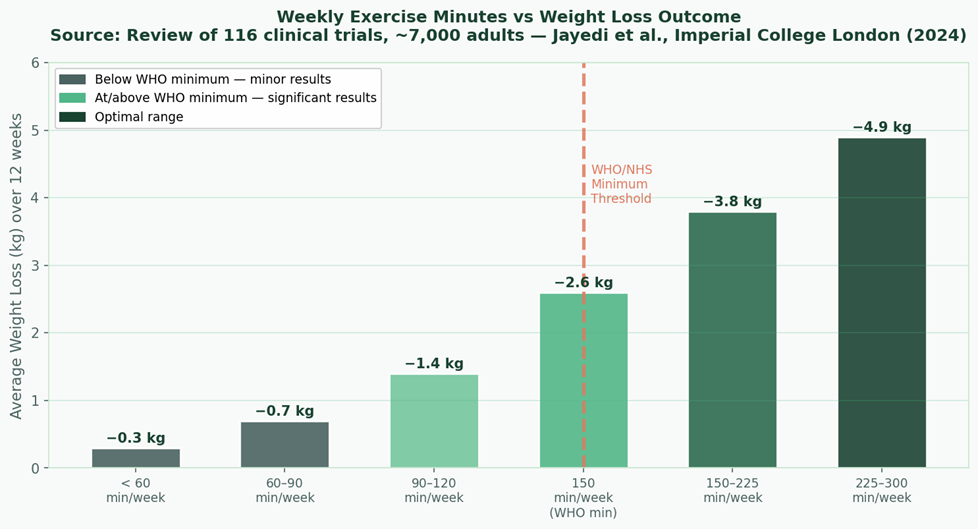
Practical Tip. Consistency matters more than intensity. Finding an activity you genuinely enjoy - dance class, home workouts, daily walks - dramatically increases the likelihood of sticking with it. Break 150 minutes into 30-minute sessions across 5 days to make it manageable.
Lifestyle Factors That Make a Real Difference
Diet and exercise are not the only factors. Sleep, stress management, and hydration all play significant, research-backed roles in weight loss.
Sleep - The Hidden Weight Loss Factor
Poor sleep disrupts hormones that control appetite. Research published in PLOS Medicine confirmed that sleep deprivation increases ghrelin (hunger hormone) and decreases leptin (satiety hormone) - causing increased hunger and food cravings. PLOS Medicine study | PubMed 2022 study
NHS Recommendation. Aim for 7 to 9 hours of quality sleep each night. Sleep deprivation also impairs muscle protein synthesis and raises cortisol - both of which actively work against weight loss goals.
Stress & Cortisol
Chronic stress raises cortisol levels. Research from Yale University published in Psychosomatic Medicine confirms that elevated cortisol promotes fat storage around the abdomen and increases cravings for high-fat, high-sugar foods. Yale/EurekAlert study | PMC review - cortisol & obesity
Practical stress-reduction strategies:
- Mindfulness and deep breathing exercises - reduce cortisol levels quickly
- Regular physical activity - one of the best natural stress reducers
- Consistent sleep schedule - stabilises the cortisol circadian rhythm
- Adequate rest periods - especially important for shift workers and caregivers
Hydration
A randomised controlled trial from the University of Birmingham, published in the journal Obesity, found that drinking 500ml of water 30 minutes before each main meal significantly helped obese adults lose more weight over 12 weeks. RCT - Obesity journal (Wiley) | ScienceDaily report
Simple Habit. Drink a full glass of water 30 minutes before meals. Research shows this reduces portion sizes naturally. The NHS recommends 6–8 glasses of fluids per day, primarily water.
When to Consider Additional Support
For some people, lifestyle changes alone are not enough. Underlying medical conditions - such as hypothyroidism, PCOS, insulin resistance, or hormonal imbalances - can make weight loss significantly harder even with consistent effort.
In these cases, prescription weight loss medication may be appropriate under medical supervision:
- Wegovy (semaglutide) - NICE-approved GLP-1 receptor agonist that reduces appetite; now available via NHS for eligible adults
- Mounjaro (tirzepatide) - dual GIP/GLP-1 receptor agonist with additional metabolic benefits
- Orlistat - reduces fat absorption; available via NHS for qualifying patients
Clinical Warning. These medicines must only be used under professional supervision alongside dietary and lifestyle changes. They are not suitable for everyone. A healthcare professional must assess suitability before any prescription is issued. NICE Guideline CG189
At HEBA Health, we provide safe access to weight management consultations and medically supervised prescriptions where appropriate. Explore our Weight Loss Service →
Building Long-Term Habits
The real secret to sustained weight loss is consistency over perfection. Crash diets may produce dramatic short-term results, but they are difficult to maintain and frequently lead to weight regain - a well-documented clinical phenomenon.
Evidence. Research consistently shows that individuals who lose weight gradually are significantly more likely to keep it off long-term, compared to those pursuing crash diets or extreme restriction. Evidence review
Sustainable habits to build:
- Follow the 80:20 approach - eat healthily 80% of the time, allow flexibility for the rest
- Track progress weekly - weigh once per week (same time, same scales) for a clearer picture
- Use smaller plates - reduces portion sizes without counting every calorie
- Plan meals ahead - reduces impulsive food choices during busy or stressed moments
- Find movement you enjoy - the best exercise is the one you actually do consistently
- Celebrate non-scale victories - better sleep, more energy, improved mood are all signs of real progress
Choosing balanced meals, finding physical activities you enjoy, and building a lifestyle that supports your health will help you not only lose weight - but keep it off permanently.


References & Sources
- NHS Inform - — Tips for Losing Weight Safely . https://www.nhsinform.scot/healthy-living/weight-loss/tips-for-losing-weight-safely/
- Royal Marsden NHS Trust - — Weight Management . https://www.royalmarsden.nhs.uk/oafu/diet/weight-management
- Royal Papworth Hospital NHS — Healthy Weight Loss Advice (PI-73) . https://royalpapworth.nhs.uk/application/files/7916/6930/4440/PI-73-Healthy-weight-loss-advice.pdf
- Guy's and St Thomas' NHS — Dietary Advice for Weight Loss Medicines . https://www.guysandstthomas.nhs.uk/health-information/dietary-advice-people-taking-weight-loss-medicines/food-and-nutrition
- East Sussex NHS — Simple Guide to Healthy Weight Loss . https://www.esht.nhs.uk/wp-content/uploads/2021/09/Your-simple-guide-to-healthy-weight-loss.pdf
- World Health Organisation — Physical Activity Guidelines . https://www.who.int/initiatives/behealthy/physical-activity
- WHO Physical Activity Guidelines — Full Text (NCBI) . https://www.ncbi.nlm.nih.gov/books/NBK566046/
- NICE Guideline CG189 — Obesity: Identification, Assessment and Management . https://www.nice.org.uk/guidance/cg189
- Hall KD et al. — Quantification of energy imbalance on bodyweight. The Lancet. PMC . 2011 . https://pmc.ncbi.nlm.nih.gov/articles/PMC3859816/
- Thomas DM et al. — 3,500 kcal rule commentary. Int J Obesity. PMC . 2013 . https://pmc.ncbi.nlm.nih.gov/articles/PMC4024447/
- Jayedi A — 150 minutes aerobic exercise & significant weight loss. Imperial College / diabetes.co.uk . 2024 . https://www.diabetes.co.uk/news/2024/dec/150-minutes-of-aerobic-exercise-key-for-significant-weight-loss.html
- Spiegel K et al. — Sleep, leptin, ghrelin, and BMI. PLOS Medicine . 2004 . https://journals.plos.org/plosmedicine/article?id=10.1371/journal.pmed.0010062
- Egmond L et al. — Acute sleep loss effects on leptin, ghrelin, adiponectin. PubMed . 2022 . https://pubmed.ncbi.nlm.nih.gov/36404495/
- Epel ES — Cortisol, stress and abdominal fat in lean women. Yale / EurekAlert . https://www.eurekalert.org/news-releases/1028090
- Parretti HM et al. — Water preloading RCT for weight loss. Obesity journal. University of Birmingham . 2015 . https://onlinelibrary.wiley.com/doi/full/10.1002/oby.21167
Ready to Take the Next Step?
If you're struggling and want personalised guidance on losing weight safely, support is available. At Heba Online Pharmacy, we combine evidence-based resources with access to medical treatments where appropriate.
Start Your Online Consultation →